

Description
Minor Pentatonic Guitar Course – Learn to Solo Across the Fretboard
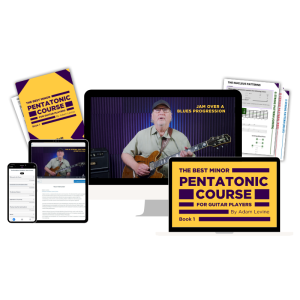
The Best Minor Pentatonic Course – Master the Guitar Fretboard
Do you know the minor pentatonic scale but still find yourself playing in the same position every time you solo?
Many guitarists learn the familiar five pentatonic shapes but struggle to connect them across the fretboard. They may know the notes and patterns individually, yet have difficulty moving naturally between positions, changing keys, or creating solos that sound musical rather than repetitive.
The Best Minor Pentatonic Course by Adam Loves Guitar was created to address this specific challenge.
The course introduces the Nucleus Patterns Method, a system designed to help guitar players understand the connections between the five minor pentatonic positions instead of treating each shape as an isolated box.
Learn the Connections Between Pentatonic Positions
The minor pentatonic scale is one of the most commonly used scales for guitar improvisation, particularly in blues, rock and related styles.
The challenge for many players isn’t learning one pentatonic shape. It’s learning how to move from one position to another without losing track of where they are on the neck.
The Nucleus Patterns Method focuses on the connections between the positions. The course teaches five essential patterns located around the borders of the pentatonic positions, creating pathways that can help players navigate the fretboard more naturally.
Instead of viewing the fretboard as five separate boxes, the approach presented in the course is designed to help students see the relationships between those shapes as part of a larger system.
Learn to Solo Across the Guitar Neck
One of the main goals of the course is to help guitarists become more comfortable moving beyond a single pentatonic position.
The training covers position playing, the relationship between the patterns and the guitar’s tuning, two-hand integration, and applying the system to backing tracks in different keys.
This can be useful for guitarists who already know the basic pentatonic shapes but want to develop greater freedom when improvising.
The Nucleus Patterns Method
The course is built around four main stages:
1. Position Playing & Riding the Rails
Learn the underlying logic behind the guitar’s tuning and how different keys relate to the same position.
2. Nucleus Patterns
Learn the five connection patterns positioned between the traditional pentatonic shapes.
3. Two-Hand Integration
Practice the connections through specially designed etudes intended to help make position transitions more natural.
4. Key Liberation
Apply the connected pentatonic system to backing tracks in different keys.
Practice With Musical Exercises
The course isn’t limited to diagrams and explanations. It also includes musical exercises designed to help guitarists practice the connections between positions.
According to the official course page, the program includes 70+ step-by-step video lessons, two guided workbooks, a Nucleus Patterns System Guide, a practice checklist, a guitar player’s digital notepad and backing tracks in multiple keys.
These materials are intended to give students a structured way to practice rather than simply watching lessons and moving on to another tutorial.
Backing Tracks for Guitar Improvisation
Backing tracks can be an important part of learning to improvise because they allow guitarists to practice concepts in a musical context.
The course includes backing tracks in multiple keys so students can apply the pentatonic patterns while practicing their movement across the fretboard.
This allows the exercises to move beyond memorizing shapes and toward practical guitar playing.
Improve Your Guitar Soloing
The course is especially focused on guitarists who want to become more comfortable with improvisation and soloing.
Rather than simply teaching another collection of scale diagrams, the training emphasizes connecting existing pentatonic knowledge and using those connections to create movement across the neck.
The official page describes applications including playing in different keys, moving between pentatonic positions and creating more connected phrases.
Designed for Guitarists Who Already Know the Basics
The course is particularly relevant to players who already have some familiarity with the minor pentatonic scale.
If you already know one or more pentatonic boxes but find yourself returning to the same position during solos, the course provides a structured method for exploring the relationships between those positions.
It can also be useful for blues and rock guitarists who want to expand their fretboard knowledge and develop more options when improvising.
Learn From Adam Levine
The course is taught by Adam Levine, a guitar educator who states that he has more than 50 years of teaching experience.
According to the official page, Levine is a Berklee College of Music graduate, previously directed the guitar program at the Dick Grove School of Music and taught at Musicians Institute in Hollywood. The page also states that he studied privately with jazz guitarist Joe Pass and has worked in studio and session environments.
30-Day Structured Learning Path
The course also presents a structured 30-day progression.
The first stage introduces position playing and the Nucleus Patterns. The following stages introduce the five patterns, work on transitions between positions and apply the system to backing tracks in different keys.
A built-in progress checklist is included to help students track their practice and work through the different stages.
What’s Included?
The current course page lists the following resources:
- 70+ step-by-step video lessons
- 2 guided workbooks
- Nucleus Patterns System Guide
- Mobile app access
- Guitar Player’s Notepad
- Practice and progress checklist
- Backing tracks in multiple keys
- Lifetime access to the course
Learn Minor Pentatonic Guitar in Any Key
One of the concepts emphasized throughout the course is applying the pentatonic system in different keys.
Once guitarists understand how the positions and connection patterns relate to one another, they can practice shifting the starting point while maintaining the same underlying system.
This approach can be especially useful for players who want to participate in jam sessions, play along with backing tracks, or improvise in different musical situations.
Take Your Guitar Playing Beyond the Pentatonic Box
Learning the minor pentatonic scale is an important step for many guitar players. However, knowing the five shapes is only part of the process.
Understanding how those shapes connect can provide another way to approach the fretboard and create more possibilities for improvisation.
The Best Minor Pentatonic Course focuses specifically on those connections through the Nucleus Patterns Method, guided lessons, etudes and backing tracks.
If you’re ready to explore the minor pentatonic scale beyond a single position and want a structured online guitar course focused on fretboard navigation and soloing, The Best Minor Pentatonic Course by Adam Loves Guitar is worth exploring.
Visit the official course page to learn more about the current program, included materials, pricing and guarantee before purchasing.


Reviews
There are no reviews yet.