

Description
The AI Blueprint Review – AI Prompt Engineering & Business Growth
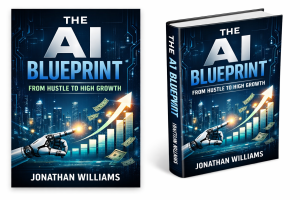
The AI Blueprint: From Hustle to High-Growth Empire – Master AI Prompt Engineering and Business Automation
The AI Blueprint: From Hustle to High-Growth Empire is a digital guide focused on helping entrepreneurs, marketers, creators, operators, and professionals learn how to use modern artificial intelligence tools more effectively. The guide focuses heavily on prompt engineering, AI-powered workflows, content creation, automation, multimodal AI, and strategies for turning AI capabilities into repeatable business processes.
As artificial intelligence continues to become an important part of digital marketing, content production, business operations, and online entrepreneurship, knowing how to communicate effectively with AI models has become increasingly useful. The AI Blueprint provides a structured approach to prompt engineering and explores different prompting methods that can be used to improve the consistency and usefulness of AI-generated outputs.
The guide introduces different prompt styles, including fill-in-the-blank prompts, open-ended prompts, hybrid approaches, structured outputs, and more advanced prompting techniques. It also discusses 13 different prompt types and the use of specialized instructions and personas to help users create more targeted AI responses.
One of the central concepts presented in The AI Blueprint is the development of a reusable prompt library. Instead of creating prompts from scratch every time a task needs to be completed, users can organize successful prompts and adapt them for recurring business activities.
The guide provides examples of prompt library components such as brand voice prompts, headline-generation prompts, competitor analysis prompts, A/B testing prompts, and product description prompts. It also discusses tools and organizational methods that can be used to make prompt collections easier to search, reuse, and maintain.
Another major topic is AI workflow automation. The AI Blueprint explores how multiple AI tasks can be connected together to create more structured workflows. These workflows can potentially be used for marketing, content production, research, analysis, advertising, customer communication, and other repetitive business processes.
The book also covers troubleshooting and optimization techniques. AI-generated responses are not always accurate or consistent, and different models can behave differently depending on the task, instructions, context, and required output. The guide discusses ways to identify common prompting problems and improve inputs through testing, refinement, and meta-prompting.
A particularly relevant area of the book is multimodal AI. Modern AI systems can work with more than just written text, and The AI Blueprint discusses approaches for working with images, PDFs, audio, and video. This can be useful for entrepreneurs and marketers who need to analyze different types of digital information or create content across multiple formats.
The guide also explores multilingual AI applications. Businesses targeting international markets can use AI to help create and adapt content for different languages and audiences. The material discusses market-specific copy and the importance of maintaining cultural and linguistic relevance when adapting content for different regions.
Another topic covered in The AI Blueprint is cross-model optimization. Different AI models can have different strengths, and the guide discusses the idea of matching particular tasks with appropriate models. The material references frontier AI systems such as GPT, Claude, Gemini, and Grok while explaining how users can test and optimize their workflows across different AI platforms.
For entrepreneurs and small business owners, the book focuses on the potential of AI to automate repetitive activities and create scalable business systems. Instead of treating AI as simply a chatbot for answering questions, the guide presents it as a tool that can be incorporated into repeatable workflows for marketing, content production, research, analysis, and other operations.
Content creators can also find relevant concepts in the book. AI prompting can be used to brainstorm ideas, create outlines, generate drafts, develop headlines, analyze existing content, create variations, and organize content production processes. The guide focuses on creating repeatable systems rather than relying on isolated prompts.
Digital marketers can apply the concepts to tasks such as advertising copy, landing-page content, product descriptions, competitor research, email marketing, social media content, and A/B testing. The guide also discusses multimodal workflows that can combine text, images, documents, and other forms of information.
The AI Blueprint is delivered as a digital PDF, allowing buyers to access the material electronically after purchase. The sales page states that delivery is provided through a direct download after payment confirmation and that the purchase is structured as a one-time payment without recurring billing.
The product is positioned as an updated edition that incorporates newer approaches to AI prompting, multimodal reasoning, longer context windows, meta-prompting, and agentic workflows. The objective is to provide readers with strategies for adapting their AI usage as modern models become increasingly capable.
The AI Blueprint may be particularly relevant to people searching for AI prompt engineering, AI business automation, ChatGPT prompting, AI marketing strategies, AI content creation, prompt libraries, AI workflow automation, multimodal AI, and advanced AI productivity techniques.
Beginners can use the material to develop a foundation in prompt engineering, while more experienced AI users can explore concepts related to structured prompting, workflow chains, model optimization, and automated systems.
The guide also emphasizes the importance of testing and refining AI workflows. Rather than assuming that one prompt will always produce the desired result, users can evaluate outputs, modify instructions, test different models, and create reusable systems based on what works for their specific requirements.
For businesses, this approach can potentially reduce repetitive manual work and create more consistent processes. However, the actual results will depend on the user’s skills, the quality of the prompts and workflows, the AI tools being used, the business model, and the specific tasks being automated.
The sales page includes promotional claims about efficiency improvements, revenue, cost savings, and business growth. These claims are marketing statements associated with the product and should not be interpreted as guaranteed results. Individual outcomes can vary considerably depending on implementation, experience, market conditions, business strategy, and other factors.
The AI Blueprint is therefore best understood as an educational resource focused on AI prompting, workflow design, content generation, and business applications of modern artificial intelligence. It does not guarantee a particular level of productivity, revenue, business growth, or financial return.
For entrepreneurs looking to incorporate AI into their daily operations, marketers searching for better prompting techniques, content creators interested in scalable AI workflows, and professionals who want to learn more about prompt engineering, The AI Blueprint provides a collection of strategies and practical concepts centered around modern AI tools.
Overall, The AI Blueprint: From Hustle to High-Growth Empire focuses on moving beyond basic AI questions and toward structured, reusable, and scalable AI workflows. Its topics include prompt engineering, prompt libraries, AI content generation, multimodal analysis, multilingual applications, model optimization, troubleshooting, automation, and business-oriented AI systems.
If you are researching how to use AI for business, how to write better AI prompts, how to automate business tasks with AI, AI marketing automation, or advanced prompt engineering techniques, this guide is positioned as a practical digital resource for exploring these subjects.




Reviews
There are no reviews yet.